Commercial Offices in Dubai and the Economy That Drives Demand

Watch
Why look at Dubai commercial offices through the economy?
An office is not bought for a view or a finish. It is bought for the companies that will pay to sit in it. That makes commercial office demand the cleanest expression of an economy: if firms are being formed, relocating and hiring, they need floorspace, and if they are not, no amount of specification will fill a floor.
So when clients ask us whether now is a sensible moment to buy a commercial unit in Dubai, we do not open with a price per square foot. We open with where the occupiers come from. Trade, logistics and finance each generate a different kind of tenant, on a different lease horizon, in a different part of the city, and the mix matters more to a twenty year hold than any single launch.
We raise this early for a simple reason. It is the easiest way to show someone that Dubai property demand is not produced by property. It is produced by the industries that bring companies and people here. Once you understand what generates the licences, the payrolls and the relocations, you stop reading the market through headline pricing alone.
What actually powers Dubai's economy?
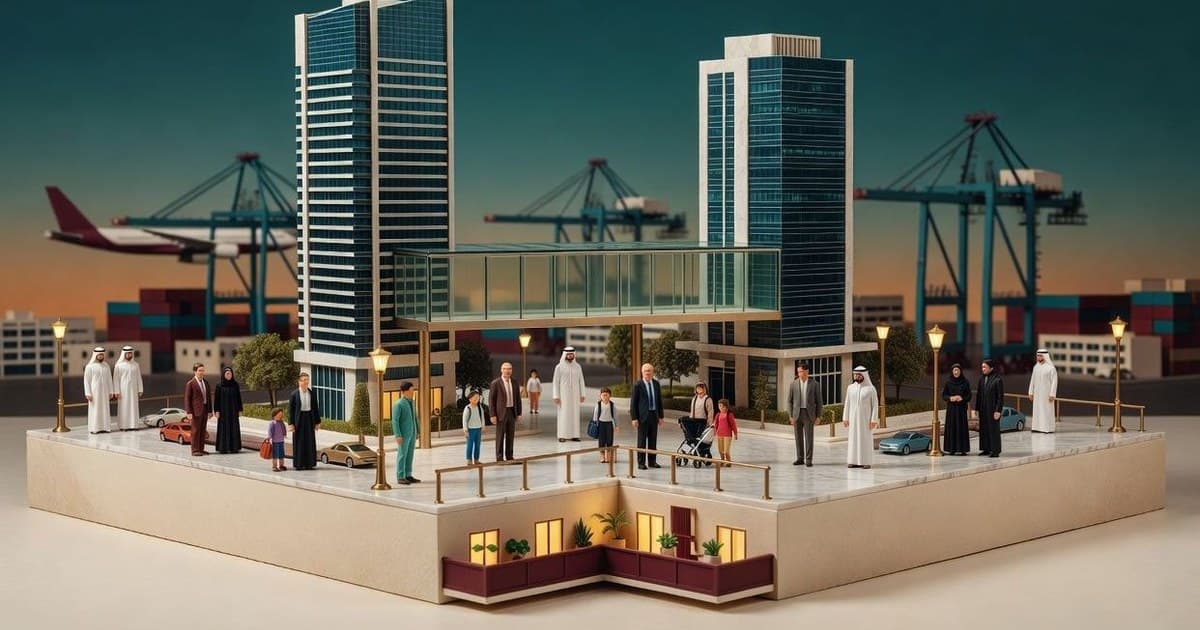
The broker's script makes the case plainly: Dubai is not built on one industry. Trade moves goods through the city. Logistics connects continents through ports and the aviation network. Finance channels institutional capital into the wider region, through hubs such as the Dubai International Financial Centre.
According to the broker, trade accounts for roughly 24% of the economy, with logistics at about 12% and finance at about 12%. Those are the broker's own figures rather than published statistics, so treat them as a shape rather than a measurement, and check the Dubai Statistics Centre or the Department of Economy and Tourism for official sector shares and reference years before you build a model on them.
Beyond those three, the script points to manufacturing, technology, tourism, healthcare and education as further contributors to a balanced base. Again, the script does not give a share for each. The point the broker is making is directional: several engines, not one. For an office buyer, that breadth is the tenant pool.
| Sector | Share of Dubai's economy, according to the broker |
|---|---|
| Trade | About 24% |
| Logistics | About 12% |
| Finance | About 12% |
| Manufacturing, technology, tourism, healthcare, education | Named as contributors, no share given in the script |
| Real estate | Described as strong, but not the dominant sector |
If real estate is not dominant, what does that tell an office buyer?
The line in the script that we find most useful is this one: real estate is strong, but it is not dominant. The script does not give real estate's own share of the economy, so we cannot put a number against it here. What we can say is what the claim implies for commercial space.
In a market where property is the economy, offices are largely leased by the property industry itself: developers, contractors, agencies, consultants. A slowdown then feeds itself, because the occupiers of the floorspace are the same people whose income depends on sales. In a market where property is one sector among trade, logistics, finance, tourism and the rest, the occupier base has other sources. A weak quarter for residential launches does not automatically mean a weak quarter for office tenants.
That is the broker's view, and it is ours too. We spend more time with clients on who the plausible occupiers of a floor are than on the specification of the lobby. Specification can be upgraded. Occupier demand is what pays the yield.
How does a diversified economy turn office demand structural rather than speculative?
The script sets out the chain in four steps. Growth comes from multiple sectors. Population growth becomes real. Jobs become long-term. Real estate demand stops being speculative and becomes structural. The broker's closing line is that capital does not just arrive in Dubai, it stays.
Worth being precise about the words. Speculative demand is demand for the asset, from buyers who intend to sell it on. Structural demand is demand for the use of the asset, from companies that need somewhere to trade from because their business is here. Speculative demand can leave in a month. Structural demand leaves when the jobs leave, and a firm that has fitted out a floor and put a team in it is slower to move than a buyer flipping a unit.
The script asserts that link rather than proving it, and we should say so. It does not provide population data, transaction volumes, rental figures or occupancy rates. If you want to test the claim on a commercial building, look at leasing depth in comparable floors nearby, renewal behaviour among sitting tenants, lease lengths and the sector mix of the occupiers already in the district. Those are the numbers that show whether companies are operating in a place or investors are simply trading it.
What this means when you buy a commercial office in Dubai
If your thesis is structural demand, buy where the occupiers already are. In practice that means proximity to the relevant business core, walkability to restaurants and meeting space, parking ratios, lift ratios, floorplate efficiency and the standard of building management, because a firm on a multi year lease will pay for convenience and will renew if the building is run well.
Match the building to the sector you expect to serve. A finance-led district draws banks, funds, law firms, insurers and family offices, which is the cluster that sits inside a hub such as DIFC. Trade and logistics occupiers behave differently and weigh access to ports, the aviation network and warehousing far more heavily. Neither is better in the abstract, but a floor priced for one type of tenant and located for another is a slow letting.
We also tell clients to look at the district as a whole, not just the tower. A central district works when offices, food and beverage, hotels and homes sit within a short walk of each other, and a unit inside that walk behaves differently from one just outside it, even at a similar price per square foot.
And hold the diversification argument at the right level. It is a reason to be comfortable with Dubai as a long-term allocation. It is not a reason to overpay for a specific floor. Sector breadth supports the city. It does not rescue a bad entry price, a poorly managed building or a service charge that eats the yield.
What diversification does not protect you from
A broad economic base reduces the chance that one industry takes the whole market down with it. It does not remove cycles. Supply arrives in waves in Dubai, and a commercial district can be well supported by jobs and still see rents flatten if too much floorspace completes at once. Read the pipeline in your specific area, not just the city-wide story.
It also does not protect you from cost. Service charges, agency and management fees, vacancy between tenancies, rent-free incentives and the cost of returning a floor to a lettable standard after a tenant leaves all sit between gross and net. Office voids can run longer than residential ones, because a company takes longer to decide than a household. We model those with clients before anyone talks about upside.
Finally, treat the sector percentages in this guide as the broker's framing. They come from the script, not from a published dataset, and no reference year is attached. The argument stands on its own logic. The numbers deserve a source before they go into a spreadsheet.
Your next step
If you are weighing Dubai commercial offices as a long-term, fundamentals-driven allocation rather than a trade, the useful conversation is specific. Which districts match your holding period. What the realistic occupier profile and lease length look like. What the net figure is after service charges, management and void assumptions. Where the office supply pipeline sits in the areas you are considering.
We work across the primary and secondary markets, so we can compare a new commercial launch against a resale floor in the same district and show you the difference in entry price, handover risk, fit-out obligation and time to first rent. For the central business districts we can also talk through how buildings are actually run, which is where most of the difference in net return shows up.
Book a call using the card on this page. Bring your budget, your timeline and whether you intend to occupy the unit yourself or let it. We will come back with a shortlist and the numbers behind it, and we will tell you plainly when the answer is to wait.
Related questions
What drives demand for commercial offices in Dubai?
The companies that occupy them. The broker's script describes an economy built on several sectors at once: trade at roughly 24%, logistics at about 12% and finance at about 12%, with manufacturing, technology, tourism, healthcare and education also contributing. That breadth is the office tenant pool, so we read office demand through sector activity rather than through property headlines.
Can an overseas buyer own a commercial office in Dubai?
It depends on the district and the title. Some districts are freehold, and DIFC is one example of a freehold area of the city, while ownership rules differ elsewhere. Confirm the tenure and the permitted use for the specific building before you commit, and we will check it with you as part of the shortlist.
Is Dubai's economy dependent on real estate?
The broker's script argues no. It puts trade at roughly 24% of the economy, logistics at about 12% and finance at about 12%, and describes real estate as strong but not dominant. Those figures are the broker's own, so check official Dubai Statistics Centre or DET data before relying on them.
What is the difference between structural and speculative demand for offices?
Speculative demand comes from buyers who want the asset in order to resell it. Structural demand comes from companies that need floorspace because their business operates here. Structural demand is slower to arrive and slower to leave, because it follows jobs and because a fitted-out floor with a team in it is expensive to vacate.
Does a diversified economy mean Dubai office rents will not fall?
No. Sector breadth reduces single-industry risk, but it does not remove cycles or supply waves. A district can have solid job support and still see rents flatten if a large volume of floorspace completes at the same time, so read the pipeline in your specific area.
Who leases offices in Dubai?
It varies by district and by sector. A finance-led hub such as DIFC clusters banks, funds, law firms, insurers and family offices, while trade and logistics occupiers weigh access to ports, the aviation network and warehousing. In our experience buildings that are well managed and within walking distance of the relevant business core tend to see stronger renewals.