Property Inheritance in the UAE: DIFC Wills and What Happens Without One

Updated September 5, 2026 · 10 min read · Sources: Federal Decree-Law 41 of 2022 on Civil Personal Status (in force 1 February 2023), Abu Dhabi Law 14 of 2021 and the Abu Dhabi Civil Family Court, Dubai Law 15 of 2017, DIFC Courts Wills Service fee schedule (2026), Dubai Courts notary fee schedule, UAE bank mortgage life-cover requirements, DLD transfer procedures.
What happens on the day: everything stops
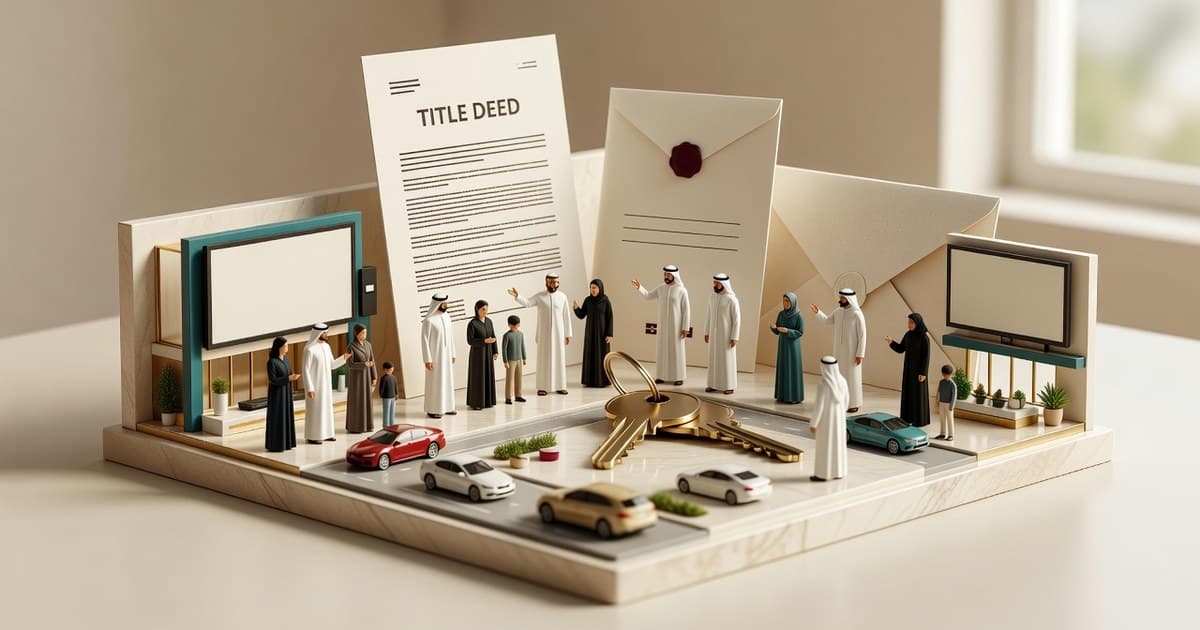
The mechanics come before the law. When a property owner dies in the UAE the title deed does not pass to anyone. The property stays registered in the deceased’s name, and the Dubai Land Department will not register a sale, accept a Form F or issue a new deed until a court has established who the heirs are and in what shares. Bank accounts in the deceased’s sole name are frozen on notification of death, and the bank releases nothing without a court-issued succession certificate. A surviving spouse who was not a joint account holder can be without access to money for weeks, and a family that has to petition the court to appoint an administrator is looking at 6 to 18 months, with documents translated, attested and in many cases apostilled from the home country.
A registered UAE will does not skip the court. What it does is tell the court what to do, in a form the court already recognises, so the process runs on your instructions rather than on a default formula, in months rather than years, and with a named person in charge from day one. That is the whole case for making one, and the rest of this guide is the detail.
The default rules without a will
The UAE runs two default systems. For Muslims, Sharia’s fixed shares apply: a widow takes one eighth of the estate where there are children and one quarter where there are none, a widower one quarter or one half, and among the children a son takes twice the share of a daughter, with parents and siblings entitled to defined shares alongside. Until 2023 those shares were also the default for a non-Muslim foreigner who died in the UAE without a will, unless the heirs successfully applied the law of the deceased’s home country, and courts historically treated UAE real estate as governed by UAE law whatever the nationality, which is why property was the asset most exposed.
Federal Decree-Law 41 of 2022 on Civil Personal Status, in force since 1 February 2023, changed the default for non-Muslims. Where a non-Muslim dies without a will, half the estate goes to the surviving spouse and the other half is divided equally among the children with no distinction between sons and daughters. Where there are no children, the estate goes to the parents equally, or half to a surviving parent and half to the siblings. Non-Muslim foreigners can also elect for the law of their home country to apply. Abu Dhabi had already moved first: Law 14 of 2021 on personal status for non-Muslims set up the Abu Dhabi Civil Family Court, which runs in English and Arabic and holds its own register of non-Muslim wills through the Abu Dhabi Judicial Department, with a standard bilingual will form introduced in 2023.
| Situation | Muslim owner, no will | Non-Muslim owner, no will (since 1 Feb 2023) | Any owner with a registered will |
|---|---|---|---|
| Spouse and children survive | Spouse one eighth (widow) or one quarter (widower); children share the remainder, sons taking twice a daughter’s share | Spouse one half; children share one half equally | As the will directs |
| Spouse, no children | Spouse one quarter (widow) or one half (widower); parents and siblings take fixed shares | Spouse one half; the deceased’s parents (or a surviving parent and the siblings) take one half | As the will directs |
| Minor children | Court appoints a guardian | Court appoints a guardian | The guardian named in the will, subject to the court |
| Who administers | Court-appointed administrator | Court-appointed administrator | The executor named in the will |
Why a will still matters after 2023
The 2023 default is fairer than the old one and still not what most families want. A surviving spouse receives half, not all, of a home they may have paid for jointly, and the other half goes to the children, who may be minors and cannot sign a sale or a mortgage release. A second marriage, a child from an earlier relationship, an estranged parent or an unmarried partner are each handled by the formula in a way that may bear no relation to the owner’s intentions. And a foreign will that has not been registered in the UAE has to be proved to a UAE court first, translated and attested, before it means anything here, which adds months at the moment the family can least afford them.
A registered UAE will fixes the beneficiaries, names an executor, names a guardian for children, and gives the court a document it processes routinely. It is the difference between a family that can sell the apartment the following spring and a family still writing to the home-country embassy the following winter. Three routes exist, and the choice between them is mostly about language, cost and which emirates the assets sit in.
The DIFC Wills Service Centre
The DIFC Courts Wills Service is the route most non-Muslim expatriates use for UAE property. It is a common-law registry in English, the will is drafted to a recognised template and registered in an appointment with a DIFC Courts officer, and probate on death is granted by the DIFC Courts, whose orders are enforced by the Dubai courts and the DLD. Since 30 June 2019 a DIFC will can cover movable and immovable assets in any of the seven emirates, not only Dubai and Ras Al Khaimah, so an owner with a flat in Dubai and a villa on Yas can deal with both in one document.
| Will type | Single | Mirror (couple) |
|---|---|---|
| Full will (all UAE assets, guardianship included) | AED 10,000 | AED 15,000 |
| Property will (UAE real estate only) | AED 7,500 | AED 10,000 |
| Guardianship will (minor children only) | AED 5,000 | AED 7,500 |
| Financial assets will (bank accounts, shares) | AED 5,000 | AED 7,500 |
| Business owners will (UAE company shares) | AED 5,000 | AED 7,500 |
| Digital assets will | AED 5,000 | AED 7,500 |
The fee is for registration; a lawyer’s drafting fee sits on top and varies widely, so ask for both numbers before you engage anyone. A property will covers UAE real estate and nothing else, which is enough for most investors whose only UAE asset is the flat. A couple registers mirror wills, one each, leaving to each other and then to the same beneficiaries. The will can be amended or revoked later, and it should be revisited on every purchase, sale, birth or divorce.
The Dubai Courts notarised will, and Abu Dhabi’s register
The second route is the Dubai Courts notary. Under Dubai Law 15 of 2017 a non-Muslim can register a will with the Dubai Courts that excludes Sharia distribution from their estate, in Arabic or bilingual form, and the notary attests it for a fee of about AED 2,020: AED 2,000 for the attestation plus AED 20 in knowledge and innovation fees, with a per-signature data-entry charge on top in some cases. It is a civil-law document processed in the onshore courts, cheaper than DIFC by a wide margin, and the natural choice for an owner whose family reads Arabic or whose lawyer works in the onshore system. Probate runs through the Dubai Personal Status Court rather than the DIFC Courts.
The third is Abu Dhabi’s own register. The Abu Dhabi Judicial Department registers non-Muslim wills under Law 14 of 2021 on a standard bilingual form, and the Abu Dhabi Civil Family Court handles the estate. For an owner whose only property is in Abu Dhabi it is the local route; for an owner with property in more than one emirate a DIFC will covering all seven is simpler than a will in each. Whichever registry you use, use one. Two wills in two registries with different instructions is a dispute waiting for a judge.
Jointly owned and mortgaged property
Joint ownership does not carry survivorship in the UAE. If a couple owns a Dubai apartment half each and one dies, the deceased’s half does not pass automatically to the survivor; it goes through succession like any other asset, under the will if there is one and under the default rules if there is not. Under the 2023 default that means the survivor holds their own half plus half of the deceased’s half, with the children holding the rest, and the DLD will register exactly that. Mirror wills leaving each half to the other are the fix, at AED 15,000 for a couple’s full wills or AED 10,000 for property wills at the DIFC.
A mortgage is the other moving part. Life cover is a condition of every UAE bank mortgage: the bank’s group policy or an assigned external policy repays the outstanding balance if the borrower dies during the term, so a maintained policy leaves the heirs with an unencumbered property. The risk is a policy that has lapsed through a missed premium, a cancelled direct debit or a change of bank, in which case the loan is still owed by the estate, and the bank holds a registered charge over the deed until it is settled. Check the policy is live once a year, keep the bank’s confirmation with the deed, and tell the executor who the lender is. A bank cannot be repaid from a frozen account, so the executor needs the will and the succession certificate to move the money in the first place.
Guardianship of minors
For a family with children the guardianship clause is the part of the will that matters most and the part most often skipped. Without one, a UAE court decides who has custody of minor children resident here, applying the default rules, and a relative abroad has no standing until the court grants it. A guardianship clause in a DIFC or Dubai Courts will names an interim guardian in the UAE, who can take the children in immediately, and a permanent guardian, usually in the home country, with the court’s confirmation. The DIFC registers it as a standalone guardianship will for AED 5,000, or as part of a full will. Both parents should sign, and the interim guardian should be someone who actually lives here and knows they have been named.
The practical order
Register the will first, before or immediately after the purchase, and choose the registry by where the assets are and what language the family will need. Tell the bank: nominate on any accounts that allow it, confirm the mortgage life policy is in force and assigned, and keep the confirmation. Keep the title deed, the will registration certificate and the mortgage and insurance papers together, physically and as scans, and give the executor and the interim guardian a copy of where they are. Review on every event: a new property, a sale, a marriage, a child, a divorce, a move between emirates. Then forget about it, which is the point.
We flag this on every purchase we advise on, and the tax and ownership guide on this site covers the wider position: the UAE charges no inheritance tax, so the only cost of getting this right is the registration fee, and the only cost of getting it wrong is borne by the people you bought the property for.
Related questions
What happens to my Dubai property if I die without a will?
The title stays in your name and the DLD will not transfer or sell until a court establishes the heirs, which takes 6 to 18 months without a will. For a non-Muslim, Federal Decree-Law 41 of 2022 splits the estate half to the spouse and half equally among the children; for a Muslim, Sharia fixed shares apply.
Does Sharia law still apply to non-Muslim expats in the UAE?
Not by default since 1 February 2023. Federal Decree-Law 41 of 2022 gives non-Muslims a civil intestacy rule, spouse one half and children one half equally, and lets them elect their home-country law. Abu Dhabi’s Law 14 of 2021 set up the Civil Family Court earlier. A registered will overrides both.
How much does a DIFC will cost?
Registration is AED 10,000 for a single full will and AED 15,000 for mirror wills; a property-only will is AED 7,500 single or AED 10,000 mirror; guardianship, financial assets, business owners and digital assets wills are AED 5,000 single or AED 7,500 mirror. Legal drafting is charged separately.
Does a DIFC will cover property in Abu Dhabi or Ras Al Khaimah?
Yes. Since 30 June 2019 a DIFC will can cover movable and immovable assets in any of the seven emirates. Abu Dhabi also runs its own register of non-Muslim wills through the Abu Dhabi Judicial Department.
Does my share of a jointly owned property pass to my spouse automatically?
No. There is no survivorship in UAE joint ownership; the deceased’s share goes through succession under the will or the default rules. Mirror wills leaving each share to the other are the fix.
What happens to the mortgage if I die?
Life cover is a condition of every UAE bank mortgage and, if the policy is in force, repays the balance so the heirs take the property unencumbered. If it has lapsed the estate still owes the loan and the bank keeps its charge on the deed until it is settled. Check the policy every year.