The Worst Properties to Buy in Dubai and How to Spot Them

Watch
Why the worst buys look perfect in the brochure
Most investors who lose money in Dubai did not buy something that looked bad. They bought a unit that looked the same as everything else on the launch deck. Same price band, same finish, same render, same promise.
The problem arrives at handover. The owner wants to sell and finds that nothing separates their unit from dozens or hundreds of others in the same building. The rent comes in below the number in the projection. The exit that looked simple on a spreadsheet takes months, and it usually takes a discount.
After more than twenty years in this market, our view is that the damage sits in three places: the terms you bought on, the apartment itself, and the position of a villa inside its community. Each one can be checked in an afternoon. None of them is visible in an aerial render.
Payment plans and incentives: reading the developer side
Start with the 20/80 plan. The pitch is clean. You pay 20 per cent, nothing more until handover, then you sell before the final 80 per cent falls due. On a 1.5 million dirham unit that is 300,000 dirhams of equity, so any uplift looks enormous as a return on cash.
Here is what the pitch leaves out. That structure attracts buyers who can only fund the 20 per cent. Everyone in the building bought for the same reason you did. At handover they all need to exit at once, because none of them can complete the purchase. You get a wave of sellers with identical units undercutting each other, and some sell at a loss to get out. A buyer has no reason to choose your unit when a cheaper copy is three floors down. The plan that made it easy to get in is the same plan that makes it hard to get out.
Oversized incentives deserve the same scepticism. According to the broker, a 30 per cent discount or a 1 per cent monthly payment plan is a red flag rather than a gift, because a strong Dubai project sells without paying buyers to come in. The question we ask is simple: what is wrong with this product that the developer has to price it this way.
The last developer risk is competing with the developer at handover. If the project sold slowly and unsold stock is still available when the building is ready, your resale unit is up against the developer's own inventory. The developer can offer a payment plan and no agency commission. On a resale, the buyer typically pays agency commission of around 2 per cent, and the 4 per cent Dubai Land Department transfer fee applies on either route. If you are buying to flip, check the absorption rate first. If supply is higher than demand, the flip is already lost.
On reputation, the broker's position is blunt and it is his opinion rather than a finding: some of the most heavily advertised names in Dubai are not the best to buy from, and marketing spend is not a substitute for build quality, delivery dates and aftercare. Judge a developer on completed buildings you can walk through, service charges five years after handover, and how the maintenance team responds today.
Apartments: oversupplied areas and oversupplied buildings
Two Dubai locations are pushed harder than anywhere else on social media: Business Bay and Jumeirah Village Circle. According to the broker, those two areas together account for roughly 25 per cent of Dubai's entire supply, most of it studios and one bedroom units. That figure is his estimate and it is worth checking against a dated supply report before you rely on it.
The mechanics matter more than the number. When thousands of near identical units hand over in the same window, landlords compete on price to fill them. Rents flatten first, then soften, and prices follow rents. You are not competing with the market, you are competing with hundreds of investors holding your exact unit.
The same thing happens inside a single building. The broker cites one Business Bay project holding around 2,000 studios, a figure we would want the project name and unit schedule to confirm. If it is close to accurate, that owner competes with 1,999 copies of their own apartment every time they list to rent or sell.
So ask for the unit mix before you sign: total units, how many are studios, how many are one bedrooms, and how many share your exact floorplan. A building with variety across layouts and sizes gives you something the next seller does not have.
Layout, balconies and the view you may lose
You can buy in a strong location and still lose money on the floorplan. Two things decide it.
The first is usable size. A one bedroom at 500 square feet is difficult to let to a tenant who has better options at the same rent. Small units exist because they let a developer sell more units per floor, not because the market asked for them.
The second is the balcony. Investors take the total area from the brochure, divide by the price, and think they have found value. According to the broker, some balconies run to around half the unit, which is a claim worth testing against the actual floorplan you are offered. Either way, run your price per square foot on internal liveable area only. The floorplan that looks cheapest per foot is often the most expensive one in the building.
Then look outside the window. If there is an empty plot between your unit and the water, that plot will eventually carry a building. The brochure view is true today and not forever, and the premium you paid for it disappears when the tower goes up. Check what is zoned and approved on every plot facing your unit before you pay for a view.
Branded residences: which brands actually add value
Branded residences are treated in Dubai as an automatic upgrade. They are not all the same product.
Hospitality brands such as Four Seasons and Dorchester bring decades of operating experience, enforced service standards, and rules the building has to meet on design, concierge and maintenance. A tenant feels that difference, which is why the premium tends to hold.
Brands from outside real estate and hospitality are a different case. A car maker, a watch house or a football club can put a name on the lobby, but they do not bring building operating standards. In our view you are then paying a premium for a logo rather than for the way the building runs. If the brand cannot tell you what it is contractually obliged to deliver inside the building, treat the premium as marketing.
Villas: position, neighbours and privacy
Villas are the part of the market where we see the biggest swings in either direction. The broker notes that villas made up only around 5 per cent of last year's new supply, a figure that needs the year and a source attached before you build a thesis on it, but the scarcity argument is why plot position matters so much.
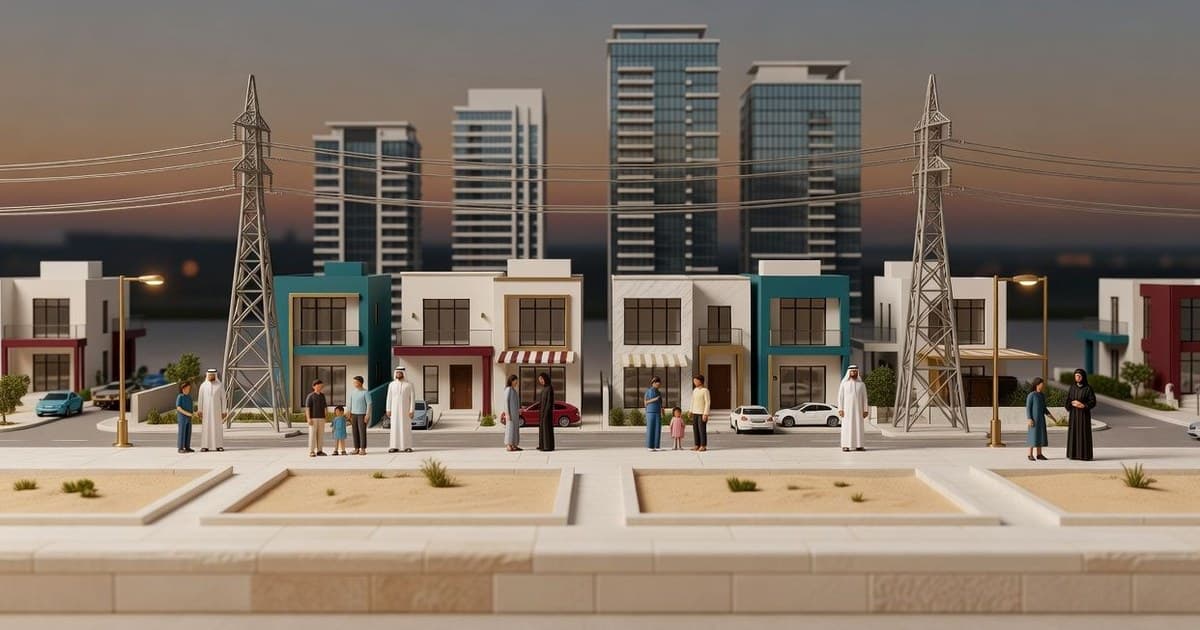
Start with what sits above and beside the plot. Open Google Maps, zoom in, and look for transmission lines and the nearest highway. Buyers react to overhead cables, and listings in affected rows sometimes advertise being away from them. The broker's stronger claims about health effects and the size of the price gap are his own and are not something we would present as established fact, but the resale effect is the part that costs you money: a smaller pool of buyers means a longer sale and a weaker price. A first row plot facing a highway carries the same issue through noise, dust and traffic, and the masterplan image usually crops the road out.
Next, look at the entry point of the whole community. The broker's view is that a very expensive villa sitting among much cheaper townhouses caps its own resale, because the buyer at the top end is paying partly for who lives around them. He points to The Oasis by Emaar as a masterplan where a high entry price is itself the product. Check the current entry price with the developer before you use that as a benchmark, and ask us for named comparables rather than taking the pattern on trust.
Finally, privacy. A villa overlooked by apartment balconies loses the two things its premium was built on: seclusion and light. Before you sign, find the nearest plot zoned for towers and work out what it does to the garden and the master bedroom.
The checks we run before a client signs, and your next step
Every trap on this page shares one feature. None of it appears in the brochure, and all of it appears at handover, when the money is already in. The good news is that each item is a question you can ask in writing before you commit.
| Trap | What to ask before you sign |
|---|---|
| Payment plan | How much of the building sold on a 20/80 plan and when the final payment falls due |
| Developer inventory | How many units remain unsold and what the developer will offer buyers at handover |
| Building density | Total units, and how many share your exact floorplan |
| Layout | Internal area excluding the balcony, and price per square foot on that number only |
| View | What is zoned and approved on every plot facing your unit |
| Villa position | Distance to power lines, the highway and the nearest plot zoned for towers |
| Community mix | The lowest entry price anywhere in the masterplan |
Where to go from here
If you are weighing up a specific unit, send it to us before you pay the booking fee. We will pull the registered transactions around it, check the unit mix in the building or the plot position in the community, and tell you plainly whether the exit is crowded.
We would rather talk you out of one project and into a better one than see you hold a unit you cannot sell. Book a call through the card on this page and bring the floorplan, the payment plan and the project name.
Related questions
Is a 20/80 payment plan always a bad deal?
No, but it changes who you will be competing with. If most of the building sold on the same plan, a large group of owners needs to exit at handover for the same reason you do, and that pushes prices down. Ask the developer how much of the project sold on that structure before you use it.
Why is a big discount treated as a warning sign?
Because in a healthy Dubai launch the product sells without unusual incentives. When a developer needs a very large discount or an extended post handover plan to move stock, our first question is what the market has already priced in about the location, the layout or the delivery record.
What fees does a buyer pay on a resale compared with buying from a developer?
The Dubai Land Department transfer fee of 4 per cent applies either way. On a resale the buyer also typically pays agency commission of around 2 per cent, while a developer sale may come with no commission and a payment plan, which is why unsold developer stock makes flipping harder.
How do I work out the real price per square foot?
Use internal liveable area only and leave the balcony and terrace out of the calculation. Two units at the same headline rate per square foot can differ significantly once you strip out outdoor space, and the cheaper looking one is often the worse buy.
Are apartments in Business Bay and JVC always a mistake?
No. Both areas have well built projects with unusual layouts and genuine demand. The risk is buying a standard studio or one bedroom in a high density tower where hundreds of identical units hand over at the same time, because that is where rents and resale prices come under pressure first.
How can I check whether my view will be blocked?
Identify every plot between your unit and the view, then check its zoning and any approved or announced project on it. An empty plot in a prime waterfront location will not stay empty, so treat a view premium as something to verify rather than assume.