Dubai South: Where the Real Investment Opportunity Sits

Watch
What is actually happening in Dubai South?
Billions of dirhams are being deployed into Dubai South right now. Whenever that much capital flows into one corridor there is opportunity, and there is also risk that never shows up on a brochure. The problem we see week to week is that most buyers in this corridor are buying a headline rather than a strategy. My background is financial economics, so I read this the way I would read any market: supply, demand drivers, payment plans and what the numbers actually say. In Dubai South, three economic engines do the heavy lifting. The first is the expansion of Al Maktoum International Airport. The figures in circulation put the programme at around 35 billion dollars, with eventual capacity of up to 260 million passengers and 12 million tonnes of cargo a year, and with DXB operations transferring across over time. Those are the published headline numbers, and we would always ask a client to check the latest official figures before underwriting anything on the back of them. The second is Jebel Ali Port, already the largest seaport in the Middle East, together with the Jebel Ali Free Zone. The broker view in the script is that JAFZA houses over 9,000 companies and that Jebel Ali is a top ten port globally. Treat those as indicative. The point that matters for property is structural: airport plus port creates a logistics corridor, and logistics corridors create jobs, and jobs create tenants. The third is Expo City, the urban and commercial focal point of the corridor under Dubai's 2040 Urban Master Plan. This is the part of Dubai South that an investor can actually buy into today with a clear demand story attached.
Why Expo City is the piece we watch most closely
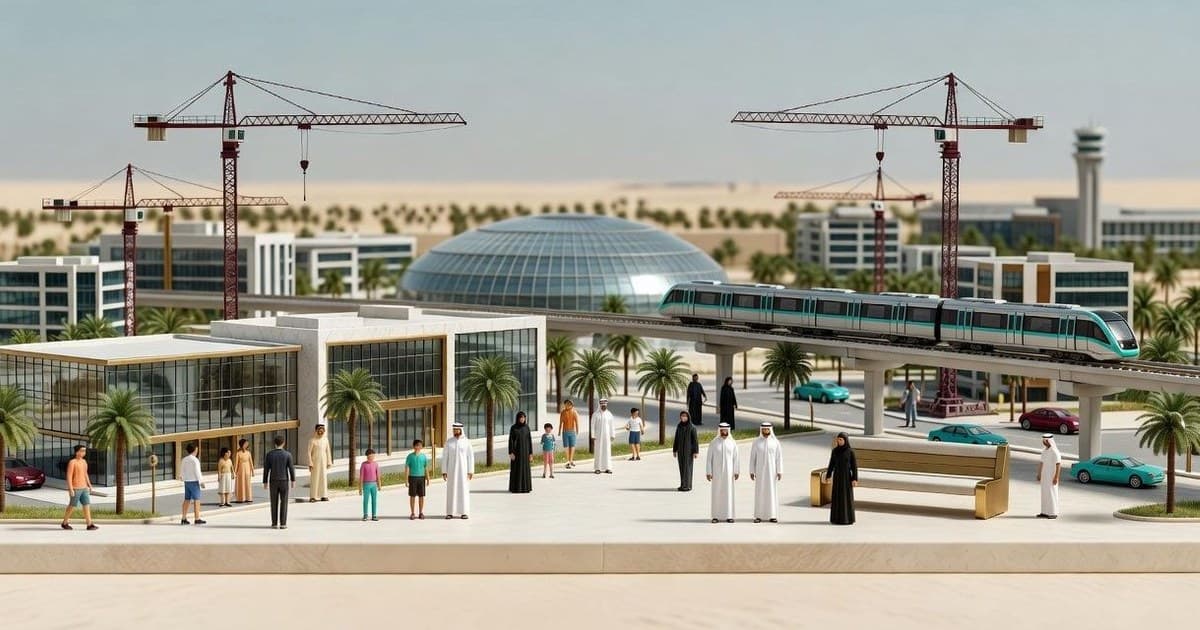
Expo City sits on the Expo 2020 site, which was built to receive millions of visitors and then repurposed into a city. That history creates an unusual position. In a normal early phase community you buy the plan and then wait years for roads, retail, schools and transport to arrive. Here, most of that arrived first. According to the broker, around 90 percent of the infrastructure is complete and operational, including a working metro line, a 14 lane highway, retail, commercial space and the region's largest exhibition centre, with over AED 50 billion already spent. We would encourage buyers to verify the spend figure independently, but the observable point stands: the built environment is largely there and what is mainly outstanding is the residential stock. The second structural feature is who is building. Expo City developments are delivered by government backed developers, and the broker's position is that there are no private developers inside the masterplan. For an investor that means consistent build standards, unified planning and one master authority controlling phasing rather than a patchwork of timelines. Our honest view: this is a bet on the government's 2040 vision as much as on a building. When public capital is being directed into a location at this scale, the downside is usually better protected than in a standalone tower with no institutional backing behind it.
Who is going to rent it? The two demand anchors
A location can look excellent on paper and still fail the only question that matters: who lives here, and why would they pay a premium to do so. Expo City has two separate answers, which is what makes it interesting to us. The first is the exhibition centre. According to the broker, it is designed to host over 600 exhibitions a year by 2032, drawing roughly 540,000 visitors a month, with Dubai World Trade Centre operations transitioning across. Those targets need checking against official sources, but the direction of travel is visible already. The broker notes that during a recent Gulfood event, split across the new venue and the World Trade Centre, a standard Rove studio room reached AED 2,000 per night. That is the short let opportunity in one number: event weeks compress demand and rates hard. The second is the free zone. Emirates, DP World, Siemens Energy and Nestle are among the names taking space. The broker's figure is over 40,000 working professionals eventually operating from Expo City, against roughly 45,000 in DIFC today. Again, worth verifying, but the implication is clear: a large base of high income employees who need long term homes near the office. That combination matters more than either anchor alone. Short let income from events is high yield but lumpy. Corporate tenants are lower yield and far more predictable. Owning an asset that can serve both means you are not relying on a single income stream, which is exactly what we want when we build a portfolio for a client.
Supply and entry pricing: what the numbers say
Supply is the part most buyers skip, and it is usually the part that determines whether you make money. The broker's figures are that Expo City will only ever have 11,000 units once the full masterplan completes, with roughly 3,500 handed over by 2030. If those caps hold, this is a tightly controlled market rather than one where the next tower dilutes your resale. On pricing, the broker puts current entry below AED 2,000 per square foot. For a location with this level of committed infrastructure and government backed developers, that is a low number relative to other tier one addresses. The indicative unit prices below are the broker's figures at the time of recording and should be treated as a starting point, not a quote. Live pricing moves with each release. A worked example. On the indicative figures, a one bedroom at around AED 1.6m bought during construction gives you two exit routes: a long let to a free zone professional, or short lets timed around the event calendar, where the Gulfood rate above shows what peak weeks can look like. The second route only works if the exhibition centre hits anything close to its stated event volume, which is why we track that pipeline rather than assume it.
| Unit type | Indicative entry price | Likely tenant |
|---|---|---|
| 1 bedroom | Around AED 1.6m | Free zone professional or short let guest |
| 2 bedroom | Around AED 2.5m | Couples and small families, corporate lets |
| 3 bedroom | Around AED 3.3m | End user families in the free zone catchment |
| Full masterplan supply | 11,000 units total | Circa 3,500 handed over by 2030 |
End user appeal: the test every asset has to pass
Real estate is unlike other asset classes in one respect. The numbers can look excellent, but if nobody wants to live in the property, the numbers are theoretical. So we apply a simple test: what does a tenant get here that they cannot get for the same money elsewhere. On the broker's account, Expo City sits about 15 minutes from Dubai Marina, so it is connected rather than isolated, with metro and major roads already in place. The amenity list includes an Emaar managed mall due to open, schools and healthcare, retail, cafes and restaurants, parks, walking and cycling trails, and horse riding tracks, with Expo Valley alongside offering wildlife and larger villas. The broker quotes luxury villa pricing running up to AED 35m in Expo City and AED 15m to 20m in Expo Valley. Those are the broker's figures and we would confirm them against live listings. The positioning point is the one we would underline. Expo City is not at the far edge of the corridor. It sits in the middle of it, which means it benefits from further Dubai South expansion rather than waiting on it.
The two traps investors fall into in Dubai South
The first trap is treating every Dubai South address as the same asset. The area is vast and the sub-communities are not equal. Take the apartment stock in the Dubai South residential district. It is a mixed developer community, which means several developers, different build standards, different handover timelines and different long term maintenance quality inside one location. Compare that with Expo City, where you are dealing with a single master authority, controlled supply, unified standards and demand drivers operating inside the community itself. Same corridor, completely different ecosystem. A strong developer in a mixed development can still make sense, but you cannot benchmark your entry price against a tier one location. Be selective on the developer, be disciplined on the price, and understand that you are buying a different kind of investment. The second trap is misjudging the time between entry and exit. Many Dubai South projects are more isolated, and demand takes longer to shift into them. Investors often assume capital appreciation or rental demand arrives on handover. In reality a community can take years to become properly livable and to attract end users willing to pay a premium. Some locations with genuine long term upside simply will not deliver it soon enough for the investment to make sense today. That is the real summary. Dubai South is not one opportunity, it is multiple micro-markets with very different risk profiles. Buy on hype and you can lock capital into an area that takes years to mature, with liquidity becoming a problem when you want out. Follow the infrastructure and the demand drivers and you are in a completely different position.
Your next step
If you are considering Dubai South, the work is not choosing a brochure, it is deciding which micro-market suits your holding period, your income requirement and your exit plan. A buyer who needs yield from year one and a buyer who can hold to 2030 should not be looking at the same project. We hold the detailed supply, appreciation and rental figures by unit type for Expo City, along with live release pricing and payment plan structures across the wider corridor. We will also tell you plainly when a project does not fit your situation. Request the report using the card on this page and we will follow up with a short call to go through your goals, budget and timeline before we send anything across.
Related questions
Is Expo City the same thing as Dubai South?
No. Dubai South is a large region built around the Al Maktoum airport expansion and the Jebel Ali port and free zone corridor. Expo City is one district inside it, on the former Expo 2020 site, with its own master authority, its own supply cap and its own demand drivers.
What does it cost to buy in Expo City today?
The broker's indicative figures are under AED 2,000 per square foot, working out at around AED 1.6m for a one bedroom, AED 2.5m for a two bedroom and AED 3.3m for a three bedroom. Those are starting points from the time of recording, not a live price list, so ask us for current release pricing.
Who would rent my apartment in Expo City?
Two distinct groups. Free zone professionals working for tenants such as Emirates, DP World, Siemens Energy and Nestle, who take long leases near the office, and short stay visitors and event staff during the exhibition calendar, when rates spike.
Why is limited supply so important here?
Because it protects resale. On the broker's figures the full masterplan is capped at 11,000 units with roughly 3,500 delivered by 2030. In a controlled market your unit is not competing with an unlimited pipeline of new launches when you come to sell or re-let.
Are the cheaper Dubai South apartments a bad buy?
Not automatically, but they are a different investment. Mixed developer communities carry variable build quality, different handover dates and slower maturity. If you buy there, be selective on the developer, be strict on the entry price and accept a longer wait before demand arrives.
How long should I expect to hold?
It depends on the sub-community. In a location where infrastructure is already operational you are closer to income from handover. In more isolated parts of the corridor it can take years for the area to become livable and attractive enough to command a premium, which is the timing risk most investors underestimate.