Driverless Pods Trial Tests the Dubai 2040 Master Plan

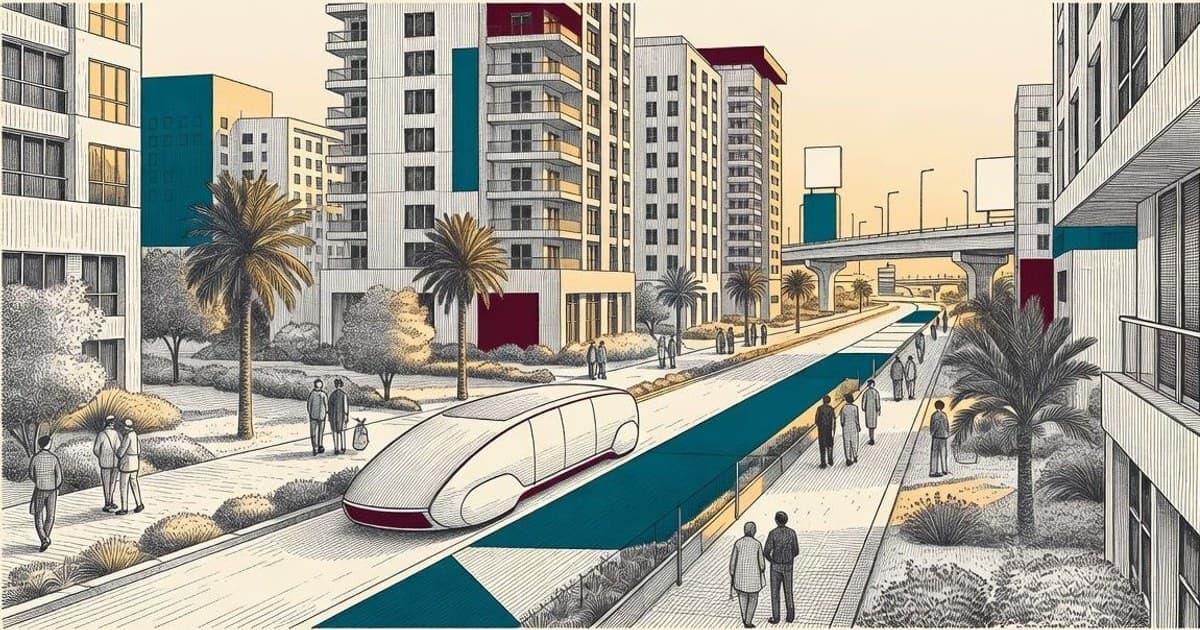
What Dubai has just put on trial
Dubai's Roads and Transport Authority has begun a four-week trial of Glydways driverless pods, according to the broker briefing this story is built on. The exact start date, duration and trial location should be confirmed with the RTA before anyone treats them as fixed.
The system is an autonomous pod network rather than a bus or a tram. The headline figures quoted in the briefing are capacity of over 10,000 people per hour in each direction, running in dedicated lanes of roughly two metres in width. We would flag that capacity number as one to verify at source, including whether it describes a single corridor or a whole network.
The CEO of the RTA's Public Transport Agency was quoted as saying the system is good for areas which have narrow pathways and lots of traffic or people. That sentence tells you the use case. This is not a replacement for the Metro. It is a way to thread transit through built-up districts where there is no room to widen a road.
Why the dubai 2040 master plan makes this worth watching
The dubai 2040 master plan sets a target of 55% of residents living within 800 metres of a main public transport station. That is a planning number, but it has a direct property consequence. An eight hundred metre radius is a ten minute walk, and the difference between a ten minute walk and a twenty five minute one changes who will rent your unit and what they will pay.
Most of Dubai's newer apartment districts do not fail on transit capacity. They fail on the last mile. A resident can reach the Metro quickly once they are on it. Getting from a tower in the middle of a community to the station is the friction point, particularly from May to September.
Pods in two metre lanes are a direct answer to that. They can be routed through existing community layouts without demolition or major road works. That is the reason we read this trial as a planning signal rather than a novelty.
The four communities named in the study
Routes are reported to be under study for Jumeirah Village Circle, Dubai Festival City, Business Bay and Mohammed Bin Rashid City. Treat "under study" literally. No commercial agreement or rollout timeline beyond the trial has been announced in the material we have seen.
What the four have in common is dense or growing residential stock sitting at an awkward distance from a main station, with internal road networks that are already busy. That is the profile this technology is aimed at.
| Community | Last-mile issue today | What a pod link would change |
|---|---|---|
| Jumeirah Village Circle | Large apartment stock, no Metro station inside the community | Walk-up access to the wider network from interior clusters |
| Business Bay | Dense towers, heavy traffic on internal roads | Short hops between towers, canal and the station |
| Dubai Festival City | Mixed retail, hotel and residential across a wide site | Movement across the site without a car |
| Mohammed Bin Rashid City | Spread-out villa and apartment districts, long internal distances | Connection from residential pockets to main corridors |
What this means for buyers and investors
We see transport news repriced in two stages. The first move is sentiment, which happens on announcement and often fades. The second is real, and it arrives when the infrastructure opens and tenants start choosing the building because of it. The second move is the one that holds in registered transaction data.
So my view is simple. Do not pay an infrastructure premium today for a route that is still under study. There is a trial, not a contract. What you can do is weight your shortlist towards buildings that would benefit most if it proceeds, because those units cost the same now as the ones that would not.
In practice that means favouring stock within a short walk of a likely corridor or a main community spine, buildings with proper drop-off and pedestrian access, and layouts that suit the car-light tenant who uses public transport by choice. If the pods never arrive, you still own a well-located unit. If they do, you own the one that benefits.
Across our Dubai and Abu Dhabi desk we treat the two markets as one, and the pattern repeats in both. Connectivity rewards the specific building, not the whole postcode.
Your next step
If you hold units in JVC, Business Bay, Festival City or MBR City, or you are buying into them this quarter, the useful exercise is a building-level read rather than a community-level one. We will pull the registered sales and rental data for your exact tower and tell you where it sits against its neighbours.
Book a call using the card on this page and I will go through it with you directly. No listing hype, just what has actually transacted and what we would do with it.
Related questions
Has Dubai confirmed that pods will be built in JVC, Business Bay, Festival City or MBR City?
No. Those four are reported as routes under study during a trial phase. No commercial agreement or rollout timeline beyond the trial has been announced, so treat any route as unconfirmed until RTA says otherwise.
Should I pay more for a property because of this news?
Not yet. We would not pay an infrastructure premium for a route that is still at study stage. Buy the building on its own merits and treat a future pod link as upside you did not pay for.
What is the 800 metre rule in the Dubai 2040 Urban Master Plan?
The plan targets 55% of residents living within 800 metres of a main public transport station, which is roughly a ten minute walk. Worth confirming the exact target date with the published plan.
Why does last-mile transit affect rents more than sale prices at first?
Tenants move annually and react quickly to commute changes, so rents adjust first. Sale prices follow once the higher rent is proven across several renewals and shows up in yields.
How do I know if my specific building would benefit?
It comes down to walking distance to a likely corridor, pedestrian access and drop-off design. Send me the tower name and I will give you a view based on registered transaction data for that building.