Etihad Rail’s Planned Stations: Where the Trains Will Stop in Dubai

Published October 1, 2026 · 7 min read · Sources: RTA, Dubai rail network 2032 map (April 2026); Time Out Dubai, The Dubai Metro is changing, here’s what it will look like by 2032 (29 April 2026); Etihad Rail.

Two railways, not one
Etihad Rail runs two separate passenger projects. The first is the national railway itself: 900 kilometres from the Saudi border to Fujairah, freight already running, with passenger trains due to start in 2026 and a Dubai to Abu Dhabi journey of about 57 minutes. The second is the announced high speed line between the two cities, designed for 350 km/h and around 30 minutes end to end. They stop in different places in Dubai, and the difference matters for which districts benefit.
Jumeirah Golf Estates: the Dubai passenger station
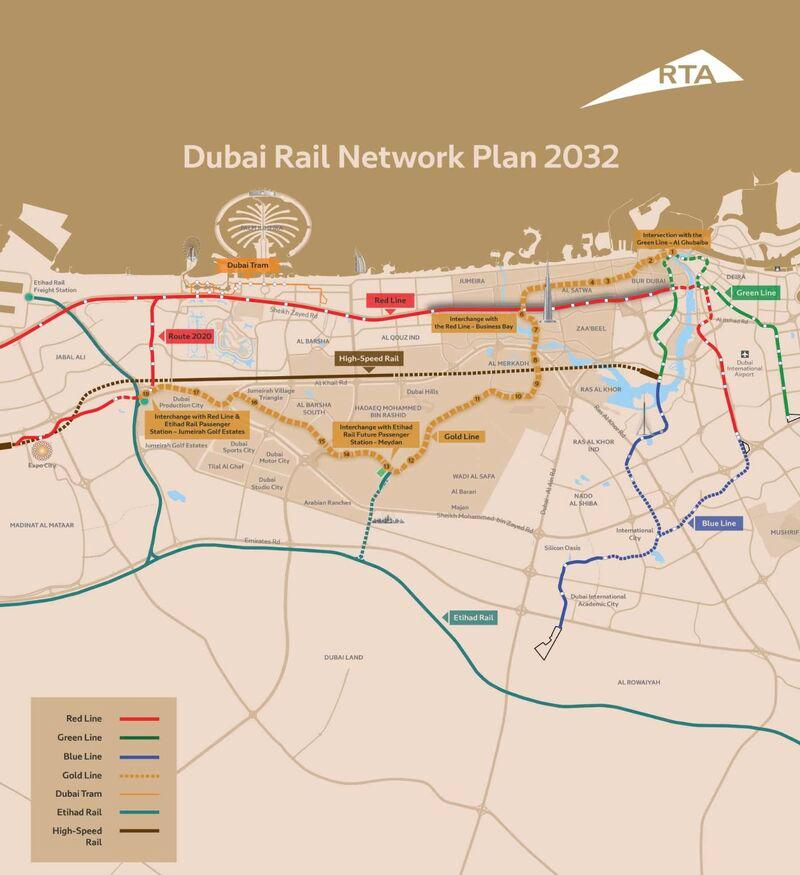
The national railway’s Dubai station sits at Jumeirah Golf Estates, on Sheikh Mohammed Bin Zayed Road in the south of the city. It is already a Red Line stop on the Route 2020 branch, and the RTA’s 2032 map ends the new Gold Line here too, which makes it a three-way interchange: national rail, the Red Line towards the Marina and Expo City, and the Gold Line north through Production City, Jumeirah Village Circle, Meydan and Business Bay to Al Ghubaiba. The communities within a short drive are Jumeirah Golf Estates itself, Al Furjan, Discovery Gardens and Jumeirah Park.
Meydan: the planned second station
The RTA’s 2032 map also marks a future Etihad Rail station at Meydan, where it will meet the Gold Line. It would be the first rail of any kind in Meydan, a short run from Business Bay, Downtown and Mohammed Bin Rashid City, and it brings the national railway close to the city centre rather than only to the southern edge. It is planned rather than dated, so treat it as a direction of travel for Meydan and MBR City, not a date to buy against.
Al Jaddaf and Al Maktoum: the high speed stops
The high speed line is planned to stop on the waterfront at Al Jaddaf, at the existing Creek station where the Green Line and the 2029 Blue Line meet. That puts Abu Dhabi about half an hour from the old city and Dubai Creek Harbour. Its second Dubai stop is Al Maktoum International Airport, which Dubai Airports expects to become the main hub by 2032. In Abu Dhabi the same line is planned to serve Saadiyat Island, Yas Island and Zayed International Airport.
What a station does to the districts around it
Rail changes which addresses count as commutable. A Jumeirah Golf Estates or Al Furjan home within a short drive of a national station is in reach of Abu Dhabi offices for the first time, and Al Jaddaf gains a direct link to the capital on top of two metro lines. The pattern from the Red Line and the Route 2020 branch is that the price gap between station districts and car-only districts opens before the line does, during the years when the route is announced and funded. The station pages on our site list the communities around every stop with their registered sale prices.
Putting a station into a buying decision
A station is worth paying for in proportion to how certain it is and how close it is. Start with certainty, and rank what you are paying for: a line that is running (the Red Line today, and Etihad Rail’s national service once passenger trains run to a timetable), then one in build (the Blue Line, for 2029), then one approved (the Gold Line, for 2032), then the planned and the announced (Meydan and the high speed line). A premium should step down along that list. Then measure from the front door to the platform, not from the community gate to the station name. Al Furjan, Discovery Gardens and Jumeirah Park sit a short drive from the Jumeirah Golf Estates interchange, so for most homes there the first and last mile is part of every journey. Then line the dates up with your own plan. An off-plan unit handing over in 2028 beside a 2032 Gold Line stop has four years in which tenants price it without the station, which matters more to a buyer counting on rent from day one than to one holding for a decade. Last, check what the market has already priced, using the registered prices on the station pages, against similar stock away from the line.
What it means if you rent
For tenants, a station helps only from the day trains run to a timetable that fits your hours, so treat the national service as a reason to look at the south of the city, not as a commute to sign a lease against until the timetable and fares are in front of you. Then add up the whole trip: the drive to Jumeirah Golf Estates, or from 2032 the Gold Line ride, then about 57 minutes on the train to Abu Dhabi, then the onward leg at the other end. For a household with one job in each city, the interchange districts are the obvious place to test that sum. For landlords, the same honesty pays. State the distance to the station and the year its line opens, because tenants check, and a listing that oversells a station only lengthens the time the unit sits empty.
Timelines belong to the railway
Passenger service on the national line is due in 2026. The high speed line is announced, not built, and its dates are Etihad Rail’s to set. The Gold Line is approved for 2032 and the Blue Line is in build for 2029. Where a station location is read off a map rather than confirmed by the operator, we say so on the line page, and we update it when the operator confirms.
Related questions
Where is the Etihad Rail station in Dubai?
The first Etihad Rail passenger station in Dubai is at Jumeirah Golf Estates, on Sheikh Mohammed Bin Zayed Road, beside the Red Line station on the Route 2020 branch, where the Gold Line will also end in 2032. A second Dubai station is planned at Meydan, connecting to the Gold Line.
When does the Etihad Rail passenger service start?
Etihad Rail’s passenger service is due to launch in 2026, with a Dubai to Abu Dhabi journey of about 57 minutes on the national line. Exact dates are set by Etihad Rail.
Where will the Abu Dhabi to Dubai high speed rail stop in Dubai?
The high speed line is planned to stop at Al Jaddaf on the creek, where it connects with the Green Line and the Blue Line, and at Al Maktoum International Airport. In Abu Dhabi it is planned to serve Saadiyat Island, Yas Island and Zayed International Airport.
Which Dubai communities are closest to the Etihad Rail station?
Jumeirah Golf Estates is next to it, with Al Furjan, Discovery Gardens and Jumeirah Park a short drive away. Jumeirah Village Circle and Dubai Production City are on the Gold Line, which will run to the same interchange from 2032.
Does a rail station raise property prices nearby?
In Dubai the Red Line and the Route 2020 branch showed a consistent premium for homes near stations, strongest in the mid-market where tenants actually ride. The gap usually opens before a line opens, once the route is funded. It is a supporting factor, not a guarantee, so compare registered sale prices around a station with those further away before buying.